
Intrarosa(prasterone)
Intrarosa (prasterone) is a small molecule pharmaceutical. Prasterone was first approved as Intrarosa on 2016-11-16. It is used to treat adrenal insufficiency, dyspareunia, lupus vulgaris, and sexual and gender disorders in the USA. It has been approved in Europe to treat postmenopause.
Download report
Favorite
Commercial
Trade Name
FDA
EMA
Intrarosa
Drug Products
FDA
EMA
New Drug Application (NDA)
New Drug Application (NDA)
Abbreviated New Drug Application (ANDA)
Abbreviated New Drug Application (ANDA)
Prasterone
Tradename | Company | Number | Date | Products |
|---|---|---|---|---|
| INTRAROSA | Millicent Pharma | N-208470 RX | 2016-11-16 | 1 products, RLD, RS |
Labels
FDA
EMA
Brand Name | Status | Last Update |
|---|---|---|
| intrarosa | New Drug Application | 2021-11-22 |
Indications
FDA
EMA
Indication | Ontology | MeSH | ICD-10 |
|---|---|---|---|
| adrenal insufficiency | — | D000309 | — |
| dyspareunia | HP_0030016 | D004414 | N94.1 |
| lupus vulgaris | EFO_1001023 | D008177 | A18.4 |
| sexual and gender disorders | — | D019968 | — |
Agency Specific
FDA
EMA
No data
ATC Codes
A: Alimentary tract and metabolism drugs
— A14: Anabolic agents for systemic use
— A14A: Anabolic steroids
— A14AA: Androstan derivatives
— A14AA07: Prasterone
G: Genito urinary system and sex hormones
— G03: Sex hormones and modulators of the genital system
— G03E: Androgens and female sex hormones in combination
— G03EA: Androgens and estrogens
— G03EA03: Prasterone and estrogen
— G03X: Other sex hormones and modulators of the genital system in atc
— G03XX: Other sex hormones and modulators of the genital system in atc
— G03XX01: Prasterone
HCPCS
No data
Clinical
Clinical Trials
107 clinical trials
View more details

Mock data
Subscribe for the real data
Subscribe for the real data
Indications Phases 4
Indication | MeSH | Ontology | ICD-10 | Ph 1 | Ph 2 | Ph 3 | Ph 4 | Other | Total |
|---|---|---|---|---|---|---|---|---|---|
| Infertility | D007246 | EFO_0000545 | 2 | 3 | 7 | 3 | 4 | 16 | |
| Breast neoplasms | D001943 | EFO_0003869 | C50 | 2 | 2 | 3 | 2 | — | 8 |
| Sjogren's syndrome | D012859 | EFO_0000699 | M35.0 | — | 2 | — | 1 | — | 3 |
| Dyspareunia | D004414 | HP_0030016 | N94.1 | — | — | 1 | 1 | — | 2 |
| Osteoporosis | D010024 | EFO_0003882 | M81.0 | — | — | — | 1 | 1 | 2 |
| Contraception behavior | D003268 | — | — | — | 1 | — | 1 | ||
| Frailty | D000073496 | R53.1 | — | — | — | 1 | — | 1 |
Indications Phases 3
Indication | MeSH | Ontology | ICD-10 | Ph 1 | Ph 2 | Ph 3 | Ph 4 | Other | Total |
|---|---|---|---|---|---|---|---|---|---|
| Systemic lupus erythematosus | D008180 | EFO_0002690 | M32 | — | 4 | 5 | — | — | 7 |
| Primary ovarian insufficiency | D016649 | EFO_0004266 | E28.3 | 3 | 4 | 2 | — | — | 5 |
| Aging | D000375 | GO_0007568 | R41.81 | — | — | 1 | — | 3 | 4 |
| Female infertility | D007247 | EFO_0008560 | N97 | 1 | 1 | 1 | — | 1 | 3 |
| Psychological sexual dysfunctions | D020018 | F52.0 | — | — | 2 | — | 1 | 3 | |
| Menopause | D008593 | EFO_0003922 | N95 | — | — | 2 | — | — | 2 |
| Hot flashes | D019584 | — | 1 | 2 | — | — | 2 | ||
| Pulmonary hypertension | D006976 | EFO_0001361 | I27.20 | — | 1 | 1 | — | — | 2 |
| Chronic obstructive pulmonary disease | D029424 | EFO_0000341 | J44.9 | — | 1 | 1 | — | — | 2 |
| Adrenal insufficiency | D000309 | — | — | 1 | — | 1 | 2 |
Show 12 more
Indications Phases 2
Indication | MeSH | Ontology | ICD-10 | Ph 1 | Ph 2 | Ph 3 | Ph 4 | Other | Total |
|---|---|---|---|---|---|---|---|---|---|
| Post-traumatic stress disorders | D013313 | EFO_0001358 | F43.1 | — | 2 | — | — | — | 2 |
| Male breast neoplasms | D018567 | — | 1 | — | — | — | 1 | ||
| Pulmonary arterial hypertension | D000081029 | — | 1 | — | — | — | 1 | ||
| Substance withdrawal syndrome | D013375 | EFO_0005800 | — | 1 | — | — | — | 1 | |
| Libido | D007989 | R68.82 | — | 1 | — | — | — | 1 | |
| Erectile dysfunction | D007172 | EFO_0004234 | F52.21 | — | 1 | — | — | — | 1 |
| Crohn disease | D003424 | EFO_0000384 | K50 | — | 1 | — | — | — | 1 |
| Hiv infections | D015658 | EFO_0000764 | B20 | — | 1 | — | — | — | 1 |
| Plasma cell neoplasms | D054219 | — | 1 | — | — | — | 1 | ||
| Xerostomia | D014987 | K11.7 | — | 1 | — | — | — | 1 |
Show 6 more
Indications Phases 1
Indication | MeSH | Ontology | ICD-10 | Ph 1 | Ph 2 | Ph 3 | Ph 4 | Other | Total |
|---|---|---|---|---|---|---|---|---|---|
| Type 1 diabetes mellitus | D003922 | EFO_0001359 | E10 | 2 | — | — | — | 1 | 3 |
| Menstruation disturbances | D008599 | HP_0400007 | N91.5 | 1 | — | — | — | — | 1 |
| Pharmacokinetics | D010599 | 1 | — | — | — | — | 1 | ||
| Synovial sarcoma | D013584 | 1 | — | — | — | — | 1 |
Indications Without Phase
Indication | MeSH | Ontology | ICD-10 | Ph 1 | Ph 2 | Ph 3 | Ph 4 | Other | Total |
|---|---|---|---|---|---|---|---|---|---|
| Polycystic ovary syndrome | D011085 | EFO_0000660 | E28.2 | — | — | — | — | 3 | 3 |
| Hyperandrogenism | D017588 | — | — | — | — | 2 | 2 | ||
| Insulin resistance | D007333 | EFO_0002614 | — | — | — | — | 2 | 2 | |
| Postmenopausal osteoporosis | D015663 | EFO_0003854 | — | — | — | — | 1 | 1 | |
| Ovulation induction | D010062 | — | — | — | — | 1 | 1 | ||
| Obesity | D009765 | EFO_0001073 | E66.9 | — | — | — | — | 1 | 1 |
| Fertilization in vitro | D005307 | — | — | — | — | 1 | 1 | ||
| Oligomenorrhea | D009839 | HP_0000876 | N91.5 | — | — | — | — | 1 | 1 |
| Hirsutism | D006628 | HP_0001007 | L68.0 | — | — | — | — | 1 | 1 |
| Endocrine system diseases | D004700 | EFO_0001379 | E34.9 | — | — | — | — | 1 | 1 |
Show 2 more
Epidemiology
Epidemiological information for investigational and approved indications
View more details
Drug
General
| Drug common name | PRASTERONE |
| INN | prasterone |
| Description | Dehydroepiandrosterone is an androstanoid that is androst-5-ene substituted by a beta-hydroxy group at position 3 and an oxo group at position 17. It is a naturally occurring steroid hormone produced by the adrenal glands. It has a role as an androgen, a human metabolite and a mouse metabolite. It is a 17-oxo steroid, an androstanoid and a 3beta-hydroxy-Delta(5)-steroid. |
| Classification | Small molecule |
| Drug class | steroids (androgens, anabolics); antiandrogens |
| Image (chem structure or protein) | |
| Structure (InChI/SMILES or Protein Sequence) | C[C@]12CC[C@H]3[C@@H](CC=C4C[C@@H](O)CC[C@@]43C)[C@@H]1CCC2=O |
Identifiers
| PDB | — |
| CAS-ID | 53-43-0 |
| RxCUI | 3143 |
| ChEMBL ID | CHEMBL90593 |
| ChEBI ID | 28689 |
| PubChem CID | 5881 |
| DrugBank | DB01708 |
| UNII ID | 459AG36T1B (ChemIDplus, GSRS) |
Target
Agency Approved
No data
Alternate
No data
Variants
Clinical Variant
No data
Financial
Intrarosa - AMAG PHARMACEUTICALS, INC.
$
€
£
₣
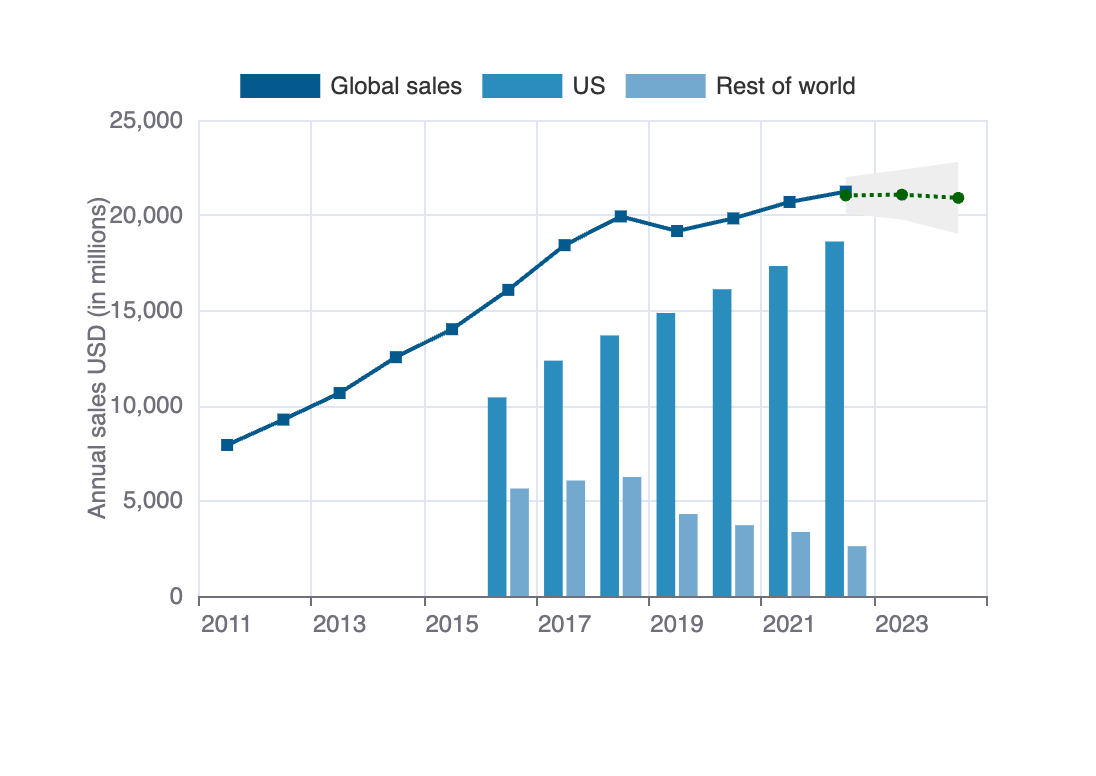
Mock data
Subscribe for the real data
Subscribe for the real data
Mock data
Subscribe for the real data
Subscribe for the real data
Tabular view
Trends
PubMed Central
Top Terms for Disease or Syndrome:

Mock data
Subscribe for the real data
Subscribe for the real data
Additional graphs summarizing 259 documents
View more details
Safety
Black-box Warning
No Black-box warning
Adverse Events
Top Adverse Reactions

Mock data
Subscribe for the real data
Subscribe for the real data
369 adverse events reported
View more details
Premium feature
Learn more about premium features at pharmakb.com
Learn more