
Angiomax, Angiox(bivalirudin)
Angiomax, Angiox (bivalirudin) is a protein pharmaceutical. Bivalirudin was first approved as Angiomax on 2000-12-15. It is used to treat unstable angina in the USA. It has been approved in Europe to treat acute coronary syndrome. The pharmaceutical is active against prothrombin.
Download report
Favorite
Commercial
Trade Name
FDA
EMA
Angiomax (generic drugs available since 2015-07-14)
Drug Products
FDA
EMA
New Drug Application (NDA)
New Drug Application (NDA)
Abbreviated New Drug Application (ANDA)
Abbreviated New Drug Application (ANDA)
Labels
FDA
EMA
Brand Name | Status | Last Update |
|---|---|---|
| angiomax | New Drug Application | 2019-06-30 |
| bivalirudin | New Drug Application | 2023-04-30 |
Indications
FDA
EMA
Indication | Ontology | MeSH | ICD-10 |
|---|---|---|---|
| unstable angina | EFO_1000985 | D000789 | I20.0 |
Agency Specific
FDA
EMA
No data
HCPCS
Code | Description |
|---|---|
| J0583 | Injection, bivalirudin, 1 mg |
Clinical
Clinical Trials
171 clinical trials
View more details

Mock data
Subscribe for the real data
Subscribe for the real data
Indications Phases 3
Indication | MeSH | Ontology | ICD-10 | Ph 1 | Ph 2 | Ph 3 | Ph 4 | Other | Total |
|---|---|---|---|---|---|---|---|---|---|
| Adenocarcinoma | D000230 | 3 | 9 | 3 | — | 2 | 15 | ||
| Covid-19 | D000086382 | U07.1 | 1 | 1 | 1 | — | — | 3 | |
| Triple negative breast neoplasms | D064726 | 1 | 1 | 1 | — | — | 2 | ||
| Ovarian neoplasms | D010051 | EFO_0003893 | C56 | — | 2 | 1 | — | — | 2 |
| Bone neoplasms | D001859 | EFO_0003820 | D16 | — | — | 1 | — | — | 1 |
| Second primary neoplasms | D016609 | — | 1 | 1 | — | — | 1 |
Indications Phases 2
Indication | MeSH | Ontology | ICD-10 | Ph 1 | Ph 2 | Ph 3 | Ph 4 | Other | Total |
|---|---|---|---|---|---|---|---|---|---|
| Breast neoplasms | D001943 | EFO_0003869 | C50 | 3 | 9 | — | — | — | 10 |
| Castration-resistant prostatic neoplasms | D064129 | 2 | 1 | — | — | — | 2 | ||
| Salivary gland neoplasms | D012468 | EFO_0003826 | D11 | — | 1 | — | — | 1 | 2 |
| Neoplasms | D009369 | C80 | — | 2 | — | — | — | 2 | |
| Lower urinary tract symptoms | D059411 | EFO_0008008 | 1 | 1 | — | — | — | 2 | |
| Male breast neoplasms | D018567 | — | 1 | — | — | — | 1 | ||
| Syndrome | D013577 | 1 | 1 | — | — | — | 1 | ||
| Precocious puberty | D011629 | E22.8 | — | 1 | — | — | — | 1 | |
| Erectile dysfunction | D007172 | EFO_0004234 | F52.21 | — | 1 | — | — | — | 1 |
| Sars-cov-2 | D000086402 | — | 1 | — | — | — | 1 |
Show 3 more
Indications Phases 1
Indication | MeSH | Ontology | ICD-10 | Ph 1 | Ph 2 | Ph 3 | Ph 4 | Other | Total |
|---|---|---|---|---|---|---|---|---|---|
| Healthy volunteers/patients | — | 7 | — | — | — | — | 7 | ||
| Hirsutism | D006628 | HP_0001007 | L68.0 | 2 | — | — | — | — | 2 |
| Myelodysplastic syndromes | D009190 | D46 | 1 | — | — | — | — | 1 | |
| Myeloid leukemia acute | D015470 | C92.0 | 1 | — | — | — | — | 1 | |
| Hematologic neoplasms | D019337 | 1 | — | — | — | — | 1 | ||
| Pancreatic neoplasms | D010190 | EFO_0003860 | C25 | 1 | — | — | — | — | 1 |
| Non-hodgkin lymphoma | D008228 | C85.9 | 1 | — | — | — | — | 1 | |
| Primary myelofibrosis | D055728 | D47.4 | 1 | — | — | — | — | 1 | |
| Multiple myeloma | D009101 | C90.0 | 1 | — | — | — | — | 1 | |
| Precursor cell lymphoblastic leukemia-lymphoma | D054198 | C91.0 | 1 | — | — | — | — | 1 |
Show 10 more
Indications Without Phase
Indication | MeSH | Ontology | ICD-10 | Ph 1 | Ph 2 | Ph 3 | Ph 4 | Other | Total |
|---|---|---|---|---|---|---|---|---|---|
| Osteoporosis | D010024 | EFO_0003882 | M81.0 | — | — | — | — | 1 | 1 |
| Metabolic syndrome | D024821 | EFO_0000195 | E88.81 | — | — | — | — | 1 | 1 |
| Polycystic ovary syndrome | D011085 | EFO_0000660 | E28.2 | — | — | — | — | 1 | 1 |
Epidemiology
Epidemiological information for investigational and approved indications
View more details
Drug
General
| Drug common name | BIVALIRUDIN |
| INN | bivalirudin |
| Description | Bivalirudin is a synthetic peptide of 20 amino acids, comprising D-Phe, Pro, Arg, Pro, Gly, Gly, Gly, Gly, Asn, Gly, Asp, Phe, Glu, Glu, Ile, Pro, Glu, Glu, Tyr, and Leu in sequence. A congener of hirudin (a naturally occurring drug found in the saliva of the medicinal leech), it a specific and reversible inhibitor of thrombin, and is used as an anticoagulant. It has a role as an anticoagulant and an EC 3.4.21.5 (thrombin) inhibitor. |
| Classification | Protein |
| Drug class | anticoagulants (hirudin type) |
| Image (chem structure or protein) | |
| Structure (InChI/SMILES or Protein Sequence) | CC[C@H](C)[C@H](NC(=O)[C@H](CCC(=O)O)NC(=O)[C@H](CCC(=O)O)NC(=O)[C@H](Cc1ccccc1)NC(=O)[C@H](CC(=O)O)NC(=O)CNC(=O)[C@H](CC(N)=O)NC(=O)CNC(=O)CNC(=O)CNC(=O)CNC(=O)[C@@H]1CCCN1C(=O)[C@H](CCCNC(=N)N)NC(=O)[C@@H]1CCCN1C(=O)[C@H](N)Cc1ccccc1)C(=O)N1CCC[C@H]1C(=O)N[C@@H](CCC(=O)O)C(=O)N[C@@H](CCC(=O)O)C(=O)N[C@@H](Cc1ccc(O)cc1)C(=O)N[C@@H](CC(C)C)C(=O)O |
Identifiers
| PDB | — |
| CAS-ID | 128270-60-0 |
| RxCUI | 60819 |
| ChEMBL ID | CHEMBL2103749 |
| ChEBI ID | 59173 |
| PubChem CID | 16129704 |
| DrugBank | DB00006 |
| UNII ID | TN9BEX005G (ChemIDplus, GSRS) |
Target
Variants
Clinical Variant
No data
Financial
Bivalirudin - The Medicines Company
$
€
£
₣
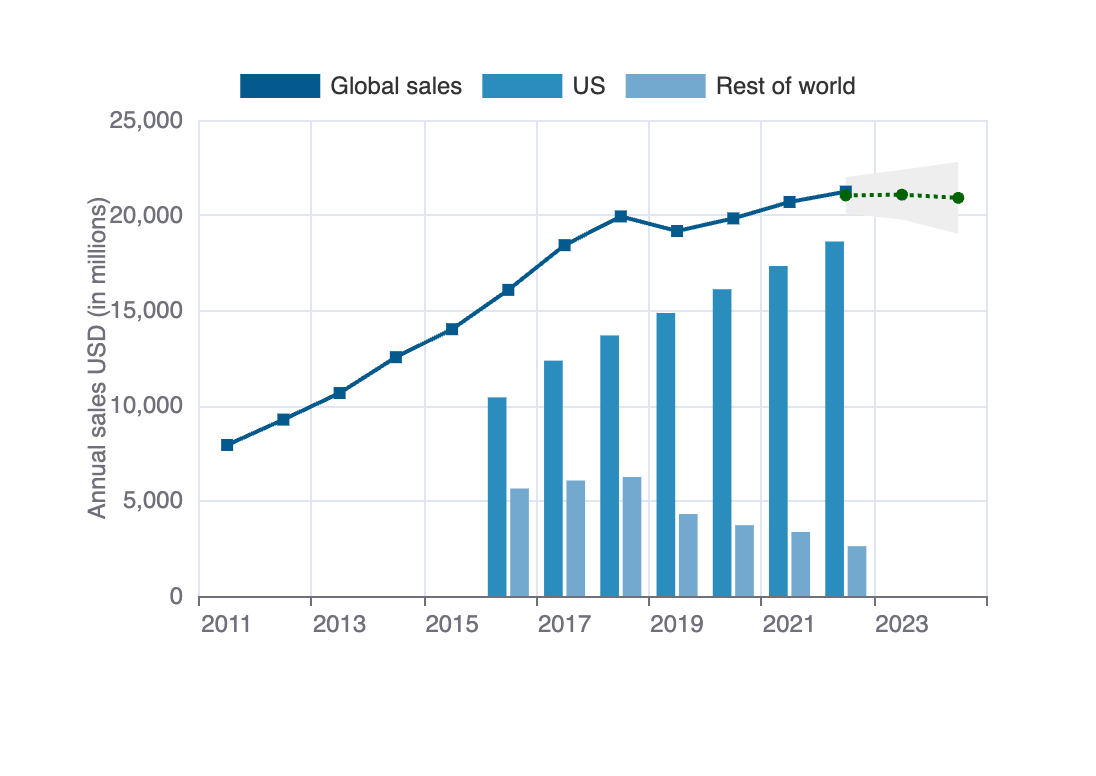
Mock data
Subscribe for the real data
Subscribe for the real data
Mock data
Subscribe for the real data
Subscribe for the real data
Tabular view
Trends
PubMed Central
Top Terms for Disease or Syndrome:

Mock data
Subscribe for the real data
Subscribe for the real data
Additional graphs summarizing 3,306 documents
View more details
Safety
Black-box Warning
No Black-box warning
Adverse Events
Top Adverse Reactions

Mock data
Subscribe for the real data
Subscribe for the real data
5,499 adverse events reported
View more details
Premium feature
Learn more about premium features at pharmakb.com
Learn more