
Inlyta(axitinib)
Inlyta (axitinib) is a small molecule pharmaceutical. Axitinib was first approved as Inlyta on 2012-01-27. It is used to treat renal cell carcinoma in the USA. It has been approved in Europe to treat renal cell carcinoma. The pharmaceutical is active against vascular endothelial growth factor receptor 2. In addition, it is known to target serine/threonine-protein kinase PLK4.
Download report
Favorite
Top 200 Pharmaceuticals by Retail Sales
Commercial
Therapeutic Areas
Therapeutic Area | MeSH |
|---|---|
| neoplasms | D009369 |
| urogenital diseases | D000091642 |
Trade Name
FDA
EMA
Inlyta
Drug Products
FDA
EMA
New Drug Application (NDA)
New Drug Application (NDA)
Abbreviated New Drug Application (ANDA)
Abbreviated New Drug Application (ANDA)
Axitinib
Tradename | Company | Number | Date | Products |
|---|---|---|---|---|
| INLYTA | CV Sciences | N-202324 RX | 2012-01-27 | 2 products, RLD, RS |
Labels
FDA
EMA
Brand Name | Status | Last Update |
|---|---|---|
| inlyta | New Drug Application | 2022-12-07 |
Indications
FDA
EMA
Indication | Ontology | MeSH | ICD-10 |
|---|---|---|---|
| renal cell carcinoma | EFO_0000376 | D002292 | — |
Agency Specific
FDA
EMA
No data
HCPCS
No data
Clinical
Clinical Trials
170 clinical trials
View more details

Mock data
Subscribe for the real data
Subscribe for the real data
Indications Phases 4
No data
Indications Phases 3
Indication | MeSH | Ontology | ICD-10 | Ph 1 | Ph 2 | Ph 3 | Ph 4 | Other | Total |
|---|---|---|---|---|---|---|---|---|---|
| Renal cell carcinoma | D002292 | 12 | 36 | 5 | — | 10 | 55 | ||
| Neoplasms | D009369 | C80 | 11 | 8 | 2 | — | 3 | 23 | |
| Non-small-cell lung carcinoma | D002289 | 3 | 10 | 1 | — | — | 11 | ||
| Kidney neoplasms | D007680 | EFO_0003865 | C64 | 1 | 5 | 2 | — | 1 | 8 |
| Neuroendocrine tumors | D018358 | EFO_1001901 | D3A.8 | — | 1 | 1 | — | — | 1 |
| Pancreatic ductal carcinoma | D021441 | — | — | 1 | — | — | 1 | ||
| Ovarian neoplasms | D010051 | EFO_0003893 | C56 | — | — | 1 | — | — | 1 |
Indications Phases 2
Indication | MeSH | Ontology | ICD-10 | Ph 1 | Ph 2 | Ph 3 | Ph 4 | Other | Total |
|---|---|---|---|---|---|---|---|---|---|
| Melanoma | D008545 | 2 | 6 | — | — | — | 8 | ||
| Liver neoplasms | D008113 | EFO_1001513 | C22.0 | 2 | 6 | — | — | — | 8 |
| Colorectal neoplasms | D015179 | 2 | 5 | — | — | 1 | 7 | ||
| Glioblastoma | D005909 | EFO_0000515 | 2 | 3 | — | — | — | 5 | |
| Gastrointestinal stromal tumors | D046152 | EFO_0000505 | C49.A | — | 1 | — | — | 1 | 2 |
| Adenoid cystic carcinoma | D003528 | — | 2 | — | — | — | 2 | ||
| Neoadjuvant therapy | D020360 | — | 2 | — | — | — | 2 | ||
| Endometrial neoplasms | D016889 | EFO_0004230 | — | 2 | — | — | — | 2 | |
| Pheochromocytoma | D010673 | — | 2 | — | — | — | 2 | ||
| Paraganglioma | D010235 | — | 2 | — | — | — | 2 |
Show 25 more
Indications Phases 1
Indication | MeSH | Ontology | ICD-10 | Ph 1 | Ph 2 | Ph 3 | Ph 4 | Other | Total |
|---|---|---|---|---|---|---|---|---|---|
| Healthy volunteers/patients | — | 4 | — | — | — | — | 4 | ||
| Gliosarcoma | D018316 | 1 | — | — | — | — | 1 | ||
| Hepatocellular carcinoma | D006528 | C22.0 | 1 | — | — | — | — | 1 | |
| Myeloid leukemia chronic-phase | D015466 | 1 | — | — | — | — | 1 | ||
| Castration-resistant prostatic neoplasms | D064129 | 1 | — | — | — | — | 1 | ||
| Stomach neoplasms | D013274 | EFO_0003897 | C16 | 1 | — | — | — | — | 1 |
| Hepatic insufficiency | D048550 | 1 | — | — | — | — | 1 | ||
| Neoplasm metastasis | D009362 | EFO_0009708 | 1 | — | — | — | — | 1 |
Epidemiology
Epidemiological information for investigational and approved indications
View more details
Drug
General
| Drug common name | AXITINIB |
| INN | axitinib |
| Description | Axitinib is an indazole substituted at position 3 by a 2-(pyridin-2-yl)vinyl group and at position 6 by a 2-(N-methylaminocarboxy)phenylsulfanyl group. Used for the treatment of advanced renal cell carcinoma after failure of a first line systemic treatment. It has a role as an antineoplastic agent, a tyrosine kinase inhibitor and a vascular endothelial growth factor receptor antagonist. It is a member of indazoles, a member of pyridines, an aryl sulfide and a member of benzamides. |
| Classification | Small molecule |
| Drug class | tyrosine kinase inhibitors |
| Image (chem structure or protein) | |
| Structure (InChI/SMILES or Protein Sequence) | CNC(=O)c1ccccc1Sc1ccc2c(/C=C/c3ccccn3)n[nH]c2c1 |
Identifiers
| PDB | 4AG8 |
| CAS-ID | 319460-85-0 |
| RxCUI | 1242999 |
| ChEMBL ID | CHEMBL1289926 |
| ChEBI ID | 66910 |
| PubChem CID | 6450551 |
| DrugBank | DB06626 |
| UNII ID | C9LVQ0YUXG (ChemIDplus, GSRS) |
Target
Agency Approved
KDR
KDR
Organism
Homo sapiens
Gene name
KDR
Gene synonyms
FLK1, VEGFR2
NCBI Gene ID
Protein name
vascular endothelial growth factor receptor 2
Protein synonyms
CD309, Fetal liver kinase 1, fetal liver kinase-1, FLK-1, KDR, Kinase insert domain receptor, kinase insert domain receptor (a type III receptor tyrosine kinase), Protein-tyrosine kinase receptor flk-1, soluble VEGFR2, tyrosine kinase growth factor receptor
Uniprot ID
Mouse ortholog
Kdr (16542)
vascular endothelial growth factor receptor 2 (Q8VCD0)
Alternate
PLK4
PLK4
Organism
Homo sapiens
Gene name
PLK4
Gene synonyms
SAK, STK18
NCBI Gene ID
Protein name
serine/threonine-protein kinase PLK4
Protein synonyms
PLK-4, Polo-like kinase 4, Serine/threonine-protein kinase 18, Serine/threonine-protein kinase Sak, Snk akin kinase
Uniprot ID
Mouse ortholog
Plk4 (20873)
serine/threonine-protein kinase PLK4 (Q9CVU6)
Variants
Clinical Variant
No data
Financial
Inlyta - Pfizer
$
€
£
₣
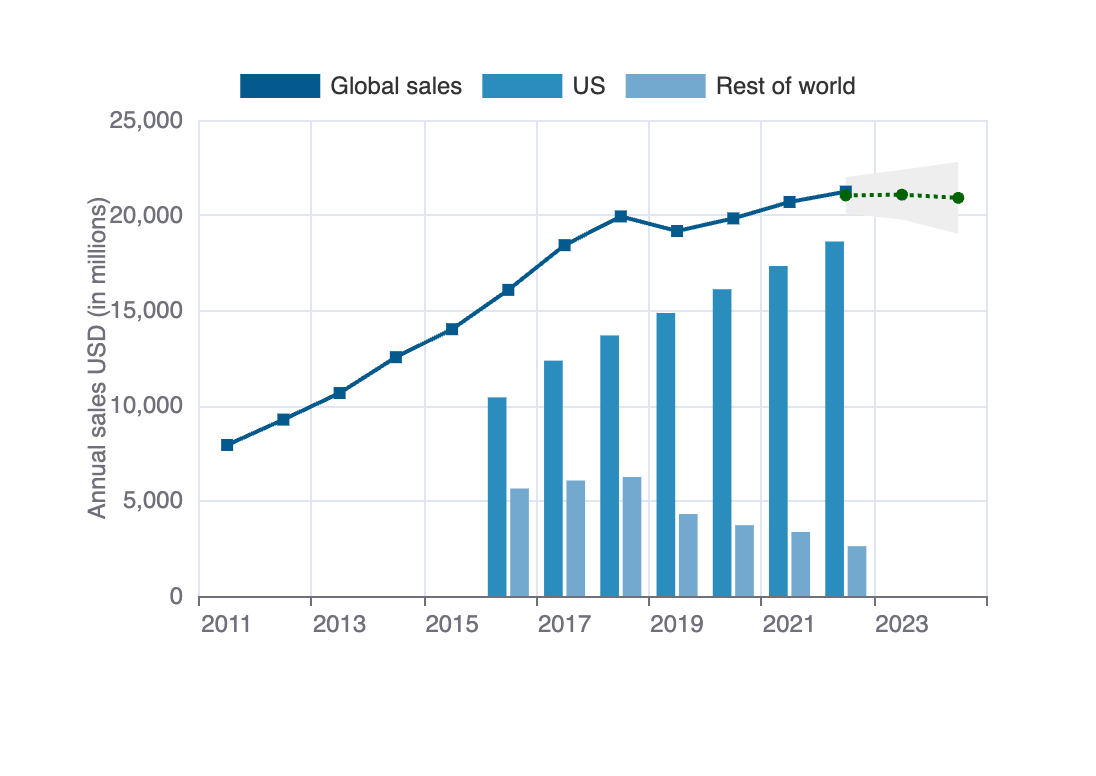
Mock data
Subscribe for the real data
Subscribe for the real data
Mock data
Subscribe for the real data
Subscribe for the real data
Tabular view
Trends
PubMed Central
Top Terms for Disease or Syndrome:

Mock data
Subscribe for the real data
Subscribe for the real data
Additional graphs summarizing 7,703 documents
View more details
Safety
Black-box Warning
No Black-box warning
Adverse Events
Top Adverse Reactions

Mock data
Subscribe for the real data
Subscribe for the real data
2,984 adverse events reported
View more details
Premium feature
Learn more about premium features at pharmakb.com
Learn more